The Lioness
(poem)

Many years ago, I was reading Jean-Jacques Rousseau, inventor of the Enlightenment concept of the noble savage and author of On Natural Religion. There is also the rather famous painter Henri Rousseau, one of whose works is titled in English The Repast of the Lion. At the time, I was getting my Rousseaus mixed up — which was which? Out of this confusion came a literal confusion (the fusion together of two things): the question, “what is the natural religion of a lion, and how might it differ from that of other animals?”
The following poem was my attempt to answer that question for myself. The Thomas Merton Society apparently agreed that it was an interesting answer, as they awarded this poem the 2010 Thomas Merton Prize for poetry of the sacred. Unfortunately, The Merton Seasonal did not include winners of that prize in their online archive for 2010, so his poem has been inaccessible for 15 years. I hope you enjoy it.
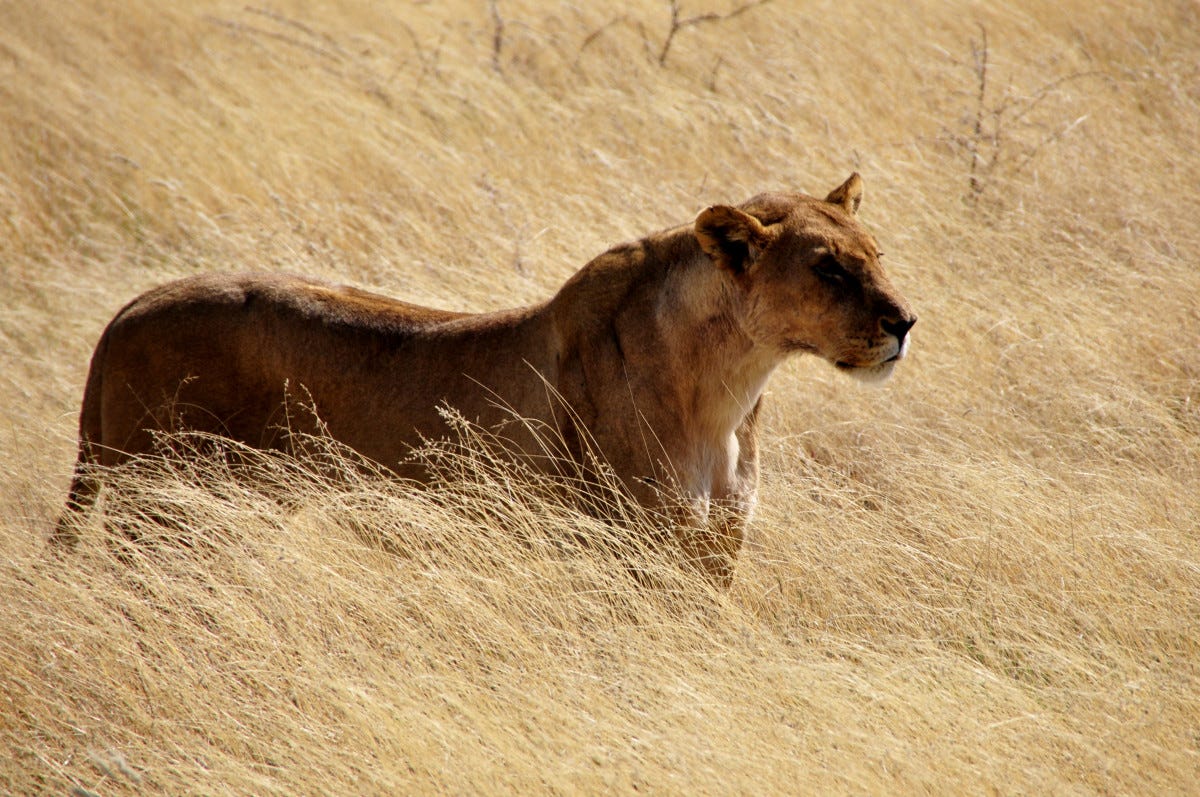
	The Lioness

Day on the savannah is an inheld breath
between the brief, cool pants of dawn and dusk,
a tawny silence aching to be broken
by any sharp sound.

I watch from a small shade.

The giraffes browse among the treetops,
within the rustling shadows of their leaves,
in the high communion only they know.

The antelope graze on the turf,
in the broad light and rippling distance;
what psalm the grass sings, only they know.

The giraffes have their patient gods in the treetops,
and the antelope theirs in the turf;
always and everywhere they are with them,
but the faint scent of mine comes to me
from some far place I do not know,

fleeing, and always further.

Once, I was a young hunter, and my worship was swift!
and once—
for one brief, exalted leap—
I had my teeth in the lean flank of heaven,
but I couldn't bring it down.
I very much like how this poem returns to its conceit in the final couplet. It reminds me of James Dickey’s “Heaven of Animals.” Though in a more secular vein appropriate for your academic background.
I can see why this is an award-winning poem. What a gift to the reader it is—a truly sublime work. Thank you for sharing!